
Automated reconciliation from bank statement to GL entry, including payment gateways
Connect bank transactions, payment gateway settlements, and ERP data into one continuous reconciliation flow. Every transaction is matched, posted, and balanced against your general ledger without manual intervention — from individual bank fees to bundled gateway deposits containing thousands of micro-transactions.
Trusted by 500+ corporate finance teams including





Full-cycle reconciliation that runs continuously, not just at month-end
Continuous matching across all sources
Bank transactions and ERP documents reconcile as they arrive — not in a batch at month-end. The reconciliation engine cross-references amounts, dates, reference IDs, and counterparty data to pair transaction automatically. When month-end comes, the work is already done.
90%+ automation from week one
Configurable rules handle repetitive entries (payroll, bank fees, taxes) from day one. TellMe learns your team's posting patterns progressively, matching payments against open AP/AR documents and suggesting GL accounts based on historical behaviour. The automation rate climbs with every correction your team makes.
Audit-ready from transaction to GL
Every posting — whether by rule, TellMe, or manual action — is logged with method, timestamp, and user. Immutable transaction identifiers ensure no transaction can be duplicated, deleted, or modified. Export reconciliation reports to Excel or PDF for auditors at any point.
Three-tier posting that learns
Rules fire first for repetitive transactions. TellMe matches the rest against open documents and learned patterns, completing postings with cost centres and analytical dimensions. Your team reviews only the exceptions that remain unmatched — not every transaction in the statement.
Bidirectional ERP integration
Reconciliation results post directly to your general ledger through connectors to SAP, NetSuite, Dynamics 365, Sage, and 20+ other ERPs. Confirmations return from the ERP to close the loop, keeping bank and ledger balances perfectly aligned without manual re-keying.
Scalable without growing your team
Transaction volume grows but your headcount doesn't need to. Whether you process hundreds of bank transactions or thousands of daily payment gateway micro-payments across multiple entities, the reconciliation engine handles the volume. Your team handles the exceptions.
One platform for bank accounting and payment gateway reconciliation
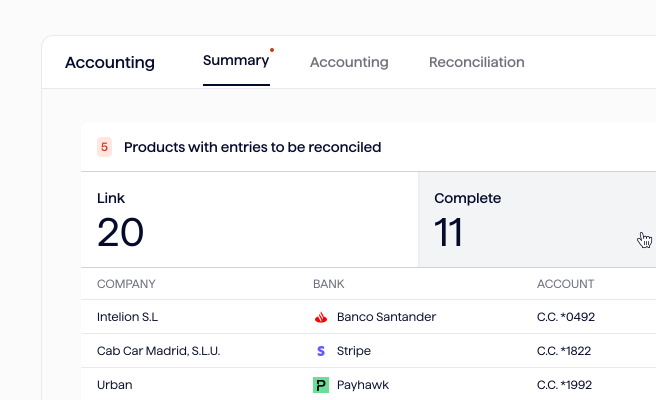
Turn every bank transaction into a justified GL entry without manual work
Bank transactions flow in via direct API connections, get posted to the right GL accounts, and reconcile against your ERP automatically. Rules handle the repetitive entries, TellMe matches the rest. Your team reviews exceptions, not every line in the statement
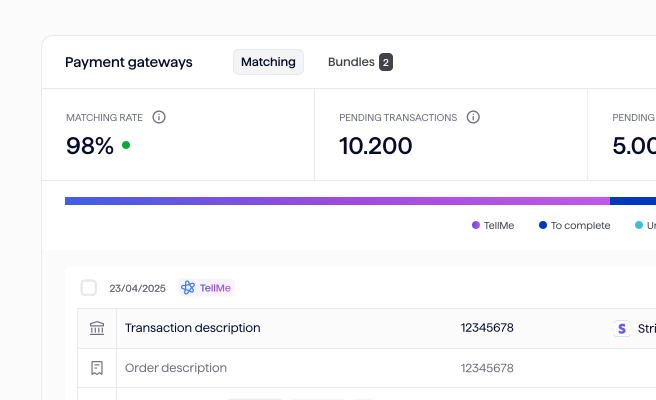
Match every sale to every deposit across all your payment gateways
Each gateway settlement is broken down into its real components — gross revenue, commissions, retentions, net deposit — and matched against individual sales automatically. Money in transit visible by gateway and expected arrival. Full fee transparency from checkout to GL.
The intelligence behind Embat
What does TellMe do?
Everything your finance department needs:
Invoice matching
Settle invoices automatically through bank transaction matching
Each incoming transaction is analysed and matched to the right invoice automatically, whether it's a 1-to-1 match, multiple invoices, or a partial payment. Accept in one click and move on.
GL account posting
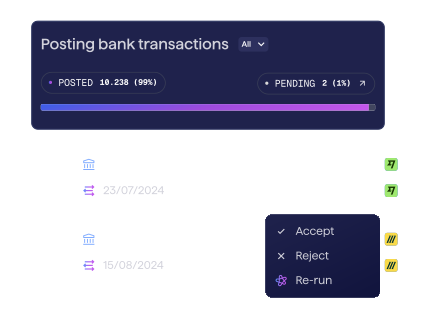
Post transactions directly to the right GL account, automatically
When there are no associated invoices, the description, counterparty, and metadata are analysed to suggest the most accurate GL account, cost centre, and analytical tags. Every transaction gets a proposal grounded in your own accounting logic.
Bank reconciliation
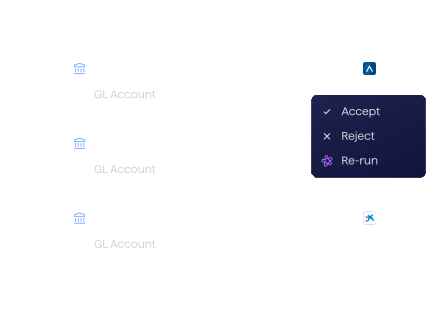
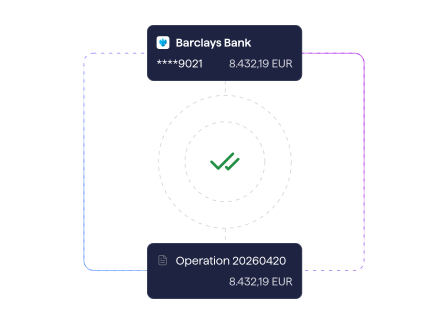
Reconcile your bank statements and GL entries in real time
Every transaction posted through Embat is automatically reconciled with its corresponding journal entry. For entries posted outside Embat, matching transactions are identified based on metadata and surfaced as suggestions.
PSP order matching
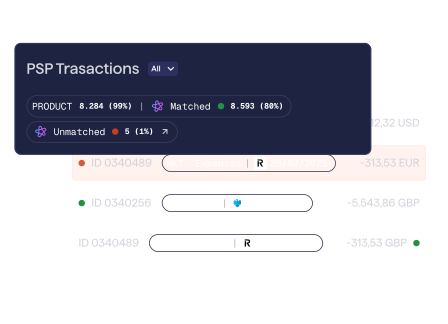
Automatically match payment gateway transactions to your sales orders
Patterns between each PSP transaction and its corresponding sale are detected automatically, performing matchings based on ID, amount, and date. Your accounting team only sees what actually needs attention.
PSP order matching
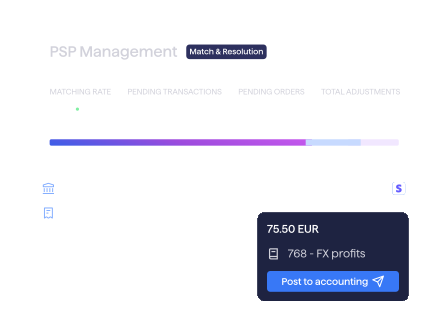
Resolve PSP discrepancies with intelligent ledger account postings
When a transaction and a sale share the same ID but amounts don't align, the difference is analysed and a posting against the appropriate ledger account is suggested. Every discrepancy gets a clear, actionable proposal.
One platform. Every bank. Full control.
Actual results from real financial teams
This is how teams already using Embat describe the change.


"Previously, 100% of one team member's time was spent on manual tasks. Today, one person can manage daily treasury in real time, spending only 10–15% of their time on it, freeing up resource for value-added work."Javier Gaya - CFO at HOFF


"If you apply a dose of AI to this, the result is highly promising and exciting. Embat's Treasury and Accounting solution is perfect for our organisation."Ángel López, CFO, Grupo CPS


"We manage a wide range of B2C, B2B, and B2G transactions with customers in 60 countries. With Embat, we have been able to bring the month-end close forward by more than 4 days and we have centralised payments, reducing the time per transaction from 10 minutes to a matter of seconds."Ignacio Marcos Pérez, CFO, thePower


"A Treasury Management System makes sense if it enables the Treasury Manager and Corporate Finance to have clear visibility across three levels: the actuals, confirmed forecasts, and an estimated forecast for strategic decisions. For us, Embat has been the solution that ensures clarity across those three levels."Michele Laria, Corporate Finance Director, Molins

Ready to transform your treasury operations?
Book a demo tailored to your specific challenges and see how Embat can transform your finance operations in weeks, not months.
Frequently Asked Questions
Account reconciliation automation replaces the manual process of downloading bank statements, matching transactions one by one, and re-keying journal entries into your ERP. Instead, bank movements flow in via API in real time, get posted to the correct GL accounts through configurable rules and intelligent matching, and reconcile against the returning ERP entry automatically. The result is continuous reconciliation throughout the month — not a 10-day crunch at period-end. Finance teams using Embat typically reach 90%+ automation and accelerate month-end close by 5 days. See it in action during your personalised demo.
Payment gateways typically bundle hundreds or thousands of individual transactions into a single bank deposit after deducting fees, retentions, and chargebacks. Embat deconstructs each settlement into its components — matching individual sales to gateway transactions using unique reference IDs, segregating fees by type, calculating rounding differences and tips, and reconciling the net amount against the bank deposit. The platform integrates with Stripe, Adyen, PayPal, Redsys, Worldpay, Mercadopago, and more. Discrepancies and missing transactions are flagged automatically for review.
Centralisation actually reduces risk compared to the alternative. When payment files are generated and transmitted in backend, no one downloads, edits, or uploads files manually — removing the step where files are most vulnerable to manipulation. Multi-factor authentication, role-based access, and approval workflows enforce governance consistently. Look for ISO 27001, SOC 2 Type II, and backend file generation as minimum requirements when evaluating any payment platform.
Yes — bidirectional integration with SAP (S/4HANA, ECC, Business One), Oracle NetSuite, Microsoft Dynamics 365, Sage, Odoo, and 20+ other ERPs. Reconciliation results post directly to your general ledger, and the returning accounting entry confirms the posting in Embat, closing the loop. Data syncs every 5–10 minutes via event-driven connectors — not overnight batch pulls. Your team continues working in the ERP normally; Embat adds the reconciliation and posting layer without disrupting existing workflows.
Your ERP is a system of record — it stores data well but was not designed for intelligent matching, automated posting, or direct bank connectivity. Most ERPs auto-post 30–40% of bank transactions at best, and reaching higher rates is nearly impossible due to rigid interfaces and lack of learning capabilities. Embat adds three layers your ERP lacks: direct API connections to 15,000+ banks (no manual downloads), a three-tier matching engine (rules, TellMe, manual) that learns and improves continuously, and a closed reconciliation loop that keeps bank and GL balances perfectly aligned. Embat enhances your ERP — it does not replace it.
All reconciliation data is protected by enterprise-grade security: AES-256 encryption at rest, TLS 1.3 in transit, and ISO 27001 and SOC 2 Type II certifications verified by independent auditors. Every posting is logged with an immutable audit trail — method, timestamp, user, and matching criteria. Banking connections use secure OAuth 2.0 authentication with encrypted credential storage, and Embat cannot initiate payments without explicit user approval. EU data residency with no cross-border transfers outside GDPR jurisdiction. Ask us in your demo for detailed security documentation.